但凡考试,都有一个准绳,这个准绳就是大纲。å�ƒé€�大纲,æ‰�能ä¿�è¯�æ–¹å�‘æ£ç¡®ï¼Œä¸�走弯路。今天,医å¦æ•™è‚²ç½‘å°�ç¼–ç»™æ–°åŠ å…¥è€ƒå�šé˜µè�¥çš„战å�‹ä»¬ç§‘普一下全国医å¦å�šå£«è‹±è¯ç»Ÿè€ƒçš„大纲,帮助大家快速了解考试时间ã€�试å�·ç»“æž„ã€�题型设置ã€�试å�·éš¾åº¦ç‰åŸºæœ¬æƒ…况。
一�考试目的
为了é…�å�ˆæˆ‘国实施医å¦ä¸“业å¦ä½�制定改é�©ï¼Œä¿�è¯�医å¦å�šå£«ç”Ÿå¦ä½�授予质é‡�,特举行全国医å¦å�šå£«è‹±è¯ç»Ÿä¸€è€ƒè¯•ã€‚考试目的在于科å¦ã€�å…¬æ£åœ°æµ‹è¯•è€ƒç”ŸæŽŒæ�¡å’Œè¿�用英è¯çš„实际能力是å�¦è¾¾åˆ°ç”³è¯·ä¸´åºŠåŒ»å¦ã€�å�£è…”医å¦å�šå£«ä¸“业å¦ä½�或攻读医å¦å�šå£«å¦ä½�的英è¯æ°´å¹³ã€‚
二�考试设计
本考试主è¦�是用于医å¦å�šå£«ç”Ÿå…¥å¦å’Œç”³è¯·åŒ»å¦å�šå£«ä¸“业å¦ä½�的一ç§�英è¯æ°´å¹³è€ƒè¯•ï¼Œå…¶å‘½é¢˜ä¸�以任何一ç§�医å¦è‹±è¯æ•™æ��为命题ä¾�æ�®ã€‚
考试内容为医å¦å…¬å…±è‹±è¯ï¼Œæ³¨é‡�çª�出临床医å¦ç‰¹ç‚¹ã€‚
本考试从å�¬åŠ›ã€�è¯�è¯ç”¨æ³•ã€�综å�ˆç�†è§£ã€�阅读和书é�¢è¡¨è¾¾äº”个方é�¢å‘½é¢˜ï¼Œå…¨é�¢æµ‹è¯•è€ƒç”Ÿçš„英è¯èƒ½åŠ›ï¼Œå¹¶çª�出对考生的英è¯åº”用和交际能力测试,以确定其是å�¦å·²è¾¾åˆ°åœ¨è�Œç”³è¯·åŒ»å¦å�šå£«ä¸“业å¦ä½�的英è¯æ°´å¹³æˆ–是å�¦å·²è¾¾åˆ°åŒ»å¦å�šå£«ç ”究生入å¦è‹±è¯æ°´å¹³ã€‚
三�试�结构
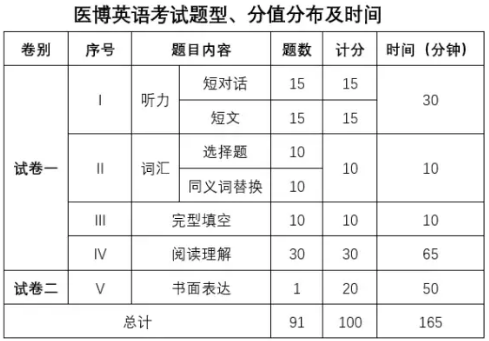
试�分为两大部分:试�一(Paper One)和试�二(Paper Two)。
试å�·ä¸€åŒ…括å�¬åŠ›ï¼ˆ30%),è¯�è¯ç”¨æ³•ï¼ˆ10%),完型填空(10%)和阅读ç�†è§£ï¼ˆ30%),ç”å�·æ—¶é—´115分钟;试å�·äºŒåŒ…括书é�¢è¡¨è¾¾ï¼ˆ20%),ç”å�·æ—¶é—´ 50 分钟,整个试å�·å…±äº”大部分,总分 100 分,ç”å�·æ—¶é—´å…± 165 åˆ†é’Ÿï¼ŒåŠ ä¸Šè€ƒåœºæŒ‡ä»¤ä¸Žè¯•å�·æ”¶å�‘时问,总共考试时间 180 分钟。
试�一(Paper One)
I. �力�解 (Listening Comprehension)
å�¬åŠ›åˆ†ä¸¤éƒ¨åˆ† Section A å’Œ Section B。ç”题时间为 30 分钟。
Section A:简çŸå¯¹è¯�(Short Conversations)
简çŸå¯¹è¯�旨在测试考生的英è¯å�¬åŠ›èƒ½åŠ›ï¼Œè¦�求考生在å�¬å®Œæ¯�个对è¯�之å�Žï¼Œæ ¹æ�®æ‰€å�¬å†…容于 12 秒钟内对æ¯�个问题å�Žçš„四个选择项å�šå‡ºæ£ç¡®é€‰æ‹©ï¼Œæ¯�个对è¯�å�Šæ��é—®å�ªè¯»ä¸€é��。
本部分共 15 �题,编�为 1-15,�题 1 分,共计 15 分。例:
�力录音:
M: The immunizations are being given at the end of the hall.
W: But I just came from that direction, and I didn't see any nurses. I didn't see any nurses downstairs either.
Q: What is the woman's problem?
�力试题:
A. She is on the wrong floor.
B. She does not know any nurse.
C. She cannot find the immunization area.
D. She received an immunization too late.
(ç”案:C)
Section B: 长对è¯�å�ŠçŸæ–‡ï¼ˆLong Conversations and Talks)
本部分由一篇长对è¯�和两篇çŸæ–‡ç»„æˆ�,旨在测试考生对英è¯ç¯‡ç« çš„å�¬åŠ›ç�†è§£èƒ½åŠ›ã€‚è¦�求考生能ç�†è§£æ‰€å�¬æ��料的ä¸å¿ƒæ€�想和主è¦�å†…å®¹ï¼Œå¹¶èƒ½æ ¹æ�®æ‰€å�¬åˆ°çš„内容进行逻辑推ç�†ã€�分æž�概括和归纳总结。
æ¯�篇æ��æ–™å�Žé™„有 5 个问题,æ¯�个问题å�Žå�‡æœ‰å››ä¸ªé€‰æ‹©é¡¹ã€‚è¦�求考生在å�¬å®Œæ¯�个问题å�Žï¼ŒäºŽ 12 秒钟内从ä¸é€‰å‡ºä¸€ä¸ªæœ€ä½³ç”案。æ¯�篇æ��æ–™å�Šæ��é—®å�ªè¯»ä¸€é��。
该部分共 15 �题,编�为 16-30,�题 1 分,共计 15 分。例:
长对��力录音
W: We have been going round the country interviewing people about their jobs, Mr. Wills, and we would like to know something about your work as a dentist. May we ask you some questions about your practice here in Little Smattering?
M: Of course you may. But you mustn't take too long as I have another patient arriving in about ten minutes.
W: I'll be as quick as I can. What made you decide to become a dentist?
M: Oh, I don't think there was ever any doubt about it. My father was a dentist in this little town all his life, and it was always taken for granted that I would take over his practice when he retired.
W: How long did you have to study before you qualified?
M: Five years. l was exempt from the preliminary year of the course, as I had passed physics, chemistry and biology at advanced level at school. So when I was nineteen I went to a dental school, which was attached to one of the larger London hospitals. The first two years of my course were spent studying anatomy, physiology and dental mechanics. During that time I was also taught how to make false teeth and all the other various appliances that are used in modem dentistry. The second part of the course, the last two years, was devoted to clinical practice in the hospital, and practical treatment of patients.
W: Were you allowed to practice on patients before you qualified?
M: Yes, but only after I had really learned what to do. Students spend many hours with a “phantom head"1473 that is a head made of plastic, which has teeth that can be extracted or filled. They practice for a long time with this before they are finally allowed to treat a real live patient.
W: When did you set up in practice here?
M: As soon as I had been admitted to the Dentists' Register, which happened shortly after I had passed my final examination.
Questions:
16. What is the woman's occupation?
17. Why did Mr. Wills decide to become a dentist?
18. When did Mr. Wills go to the dental school?
19. What courses did Mr. Wills have to learn in the dental school?
20. How long should students practice before they are finally allowed to treat a real live patient?
�力试�
16. A. Journalist.
B. Dentist.
C. Headhunter.
D. Social worker.
17. A. Because he had always wanted to be a dentist.
B. Because he was interested in medicine.
C. Because he would follow his father's footsteps.
D. Because he took over his father's practice in Little Smattering.
18. A. Five years ago.
B. When he was nineteen.
C. After he passed a dental test.
D. After he passed a biology test at advanced level.
19. A. Physics, chemistry and biology.
B. Clinical practice in the hospital.
C. Making false teeth and other various appliances.
D. Anatomy, physiology and dental mechanics.
20. A. Few hours.
B. A long time.
C. Two years
D. Five years.
(ç”案: 16. A 17. C 18. B 19. D 20. B)
çŸæ–‡å½•éŸ³ï¼š
To quickly review the main points covered in Chapter Seven, the most important part of the system of nerve is the brain. The brain controls most of the body's activities. Messages between the brain and the spinal cord are carried by nerves, which are made up of special cells called nerve cells. Nerve cells are found in the brain, spinal cord, spinal nerves and the organs we use to see, hear, smell, taste and touch.
Nerve cells have long string-like fibers that carry messages. These fibers have branched ends to send and receive messages. Remember that nerve cells are so small that they cannot be seen without a microscope. But one fiber from a nerve cell may stretch as long as three feet.
There are many kinds of nerve cells, and this chapter deals mainly with three kinds. The sensory nerve cells carry messages of heat, light, sound and pressure from the skin, muscles and organs inside the body. Motor nerve cells carry messages to the muscles, and this causes the muscle to move. Connecting nerve cells go between the sensory nerve cells and motor nerve cells. After the messages go from the spinal cord to the brain, the brain sends messages through the motor nerve cells to the muscles. All these different nerve cells help us see, hear, taste, smell and feel.
Now if you have no further questions about Chapter Seven, we'll go on to talk about the chemical processes involved in this transfer of messages.
Questions 21-25 are based on the following questions:
21. What is the source of the speaker's information?
22. What role do nerve fibers play?
23. What does a nerve fiber look like according to the speaker?
24. How many kinds of nerve cells are discussed in this talk?
25. Which of the following nerve cells sends messages to the muscles?
�力试�:
21. A. A medical textbook.
B. A medical journal.
C. Some microscope slides.
D. The speaker's current research.
22. A. Reproducing themselves.
B. Stretching and growing.
C. Attaching themselves to muscles.
D. Carrying messages.
23. A. Elongated and stringy.
B. Round and compact.
C. Flat and transparent.
D. Flexible and chainlike.
24. A. One. B. Two. C. Three. D. Four.
25. A. Sensory nerve cells.
B. Motor nerve cells.
C. Connecting nerve cells.
D. All of the above.
(ç”案:21. A 22. D 23. A 24. C 25. B)
II. è¯�è¯ç”¨æ³• (Vocabulary)
è¯�è¯ç”¨æ³•æ—¨åœ¨æµ‹è¯•è€ƒç”Ÿå¯¹è‹±è¯è¯�汇和çŸè¯çš„ç�†è§£å’Œä½¿ç”¨èƒ½åŠ›ï¼Œåˆ†ä¸¤éƒ¨åˆ†ï¼šSection A å’Œ Section B。
Section A: 填空 (Fill in the blank)
该部分考题的题干为一个或两个å�¥å�,å�¥ä¸ç•™æœ‰ä¸€å¤„空白,题干å�Žé™„四个选择项,è¦�求考生从ä¸é€‰å‡ºä¸€ä¸ªæœ€ä½³ç”案,填入题干å�Žä½¿è¯¥å�¥å�è¯æ³•æ£ç¡®ï¼Œé€»è¾‘å�ˆç�†ï¼Œæ„�æ€�完整。
该部分共 10 �题,编�为 31-40,�题 0.5 分,共计 5 分。例:
31. The "City of Hope" in California is dedicated to relieving pain and prolonging life with ______.
A. expectancy
B. longevity
C. dignity
D. identity
(ç”案:31. C)
Section B:多选题 (Multiple choice)
该考题的题干为一个或两个å�¥å�,å�¥ä¸æœ‰ä¸€è¯�或çŸè¯ä¸‹é�¢åˆ’有横线,题干å�Žé™„四个选择项,è¦�求考生从ä¸é€‰å‡ºä¸€ä¸ªå’Œè¯�ä¸åˆ’线部分的æ„�义相å�Œæˆ–近似的最佳ç”案。本题测试的è¯�è¯ï¼Œä¸�超出考试大纲所附è¯�汇表的内容范围。
该部分共 10 �题,编�为 41-50,�题 0.5 分,共计 5 分。例:
41. You cannot burden your memory with too much information.
A. retain B. load C. retrieve D. associate
(ç”案:41. B)
III. 完型填空(Cloze)
本部分共 10 �题,计 10 分。考试时间 10 分钟。
æ¤é¢˜ç�€é‡�æµ‹è¯•è€ƒç”Ÿåœ¨ç¯‡ç« æ°´å¹³ä¸Šç�†è§£å’Œè¿�用è¯è¨€çš„综å�ˆèƒ½åŠ›ã€‚è¦�求考生阅读一篇约 200 è¯�的英è¯çŸæ–‡ï¼Œå…¶ä¸ç•™æœ‰ 10 处空白。æ¯�一空白附有四个选择项,考生在ç�†è§£å…¨æ–‡å¤§æ„�和上下文æ„�æ€�的基础上,从四个选择项ä¸é€‰å‡ºä¸€ä¸ªæœ€ä½³ç”案,使çŸæ–‡åœ¨è¯æ³•ã€�用è¯�ã€�å�¥åž‹ç»“构和上下文逻辑关系ç‰æ–¹é�¢éƒ½èƒ½å®Œå–„。
该部分 10 个�题的编�为 51-60。例:
In June a Senate committee released its report on euthanasia and assisted suicide. A majority of its members recommended against legalizing the two procedures. As the public debate in this country intensifies, it is instructive to look at the Netherlands, where euthanasia, while not 51 , has been increasingly tolerated by the courts in recent years.
In the intensive-care unit of a Dutch hospital, a man lay with chronic leukemia 52 with pneumonia. His hands and feet were bound, and he was being respired with a tube in his throat. A young assistant physician appeared at his bedside and said, “I assume that if your heart fails, you don't want to be resuscitated."
Unable to talk, the man shook his head vehemently from left to right, the only movement he could make to 53 that indeed he did want to be resuscitated. Despite the seriousness of his illness, he knew he could still live for years. But the physician, misinterpreting his 54 , said, “That's assumed, then," made a note on the patient's chart and moved on.
The sick man was in a panic. Fortunately, 55 gestures, he managed to tell his son, who was able to prevent a tragic mistake.
This is an example of how increasingly casually doctors in the Netherlands are 56 the ending of life by withdrawing medical treatment—a procedure known 57 passive euthanasia. It is only one of many. Tom Schalken, professor of criminal law at the Free University of Amsterdam, was a member of a commission that 58 euthanasia in 1990. 0f an annual total of 130, 000 deaths, in 2,300 cases, physicians reported that euthanasia had been carried out at the 59 of the patient. But the commission 60 that in more than 1, 000 instances, physicians had ended a life without an explicit request for example, with patients in coma or newborn babies.
51. A. being legalized
B. legalizing
C. legalized
D. legalizes
52. A. connected
B. included
C. related
D. combined
53. A. indicate
B. notice
C. notify
D. appear
54. A. symptom
B. gesture
C. symbol
D. sign
55. A. by reason of
B. in place of
C. in the course of
D. by means of
56. A. dealing with
B. getting with
C. solving
D. coming over
57. A. for B. as C. of D. after
58. A. came into
B. looked into
C. went into
D. grew into
59. A. request
B. command
C. demand
D. recommend
60. A. ascertained
B. is ascertained
C. has ascertained
D. was ascertained
(ç”案:51. C 52. D 53. A 54. B 55. D 56. A 57. B 58. B 59. A 60. A)
IV. 阅读�解(Reading Comprehension)
本部分共 30 �题,计 30 分。考试时间 65 分钟。
该部分由 6 篇阅读çŸæ–‡ç»„æˆ�。æ¯�篇çŸæ–‡çº¦ 300 个å�•è¯�,å�Žé™„ 5 个问题,æ¯�个问题å�Žå�‡æœ‰å››ä¸ªé€‰æ‹©é¡¹ã€‚
æ¤ç±»é¢˜ç›®æ˜¯æµ‹è¯•è€ƒç”Ÿé€šè¿‡é˜…读英文书刊获å�–ä¿¡æ�¯çš„能力(包括阅读速度和ç�†è§£ç¨‹åº¦ï¼‰ã€‚è¦�求考生在读完一篇文å—æ��æ–™å�Žï¼Œèƒ½ç�†è§£å…¶ä¸»é¢˜æ€�想ã€�主è¦�内容和主è¦�ç»†èŠ‚ã€‚èƒ½æ ¹æ�®æ‰€è¯»æ��料的内容进行推ç�†åˆ¤æ–,ç�†è§£æŸ�些è¯�å’ŒçŸè¯åœ¨å…·ä½“è¯å¢ƒä¸çš„æ„�义,ç�†è§£å�¥ä¸Žå�¥ä¹‹é—´çš„内在逻辑关系能领会作者的观点和æ€�想感情,判æ–其对事物的æ€�度。测试æ��料主è¦�是涉å�ŠåŒ»å¦ç§‘æ™®ã€�自然科普和人文ç‰å�„ç§�题æ��和体è£�çš„æ–‡ç« ã€‚è¦�æ±‚è€ƒç”Ÿæ ¹æ�®æ‰€è¯»æ��料的内容,从æ¯�é�“题的选择项ä¸é€‰å‡ºä¸€ä¸ªæœ€ä½³ç”案。
该部分 30 个�题的编�为 61-90。例:
Passage one
It has almost become dogma that athletes require greater amounts of protein than sedentary individuals. In addition to eating more protein, athletes also need to be aware of the times of day at which they consume both different types and amounts of protein. The post-workout meal is one of the most important times and meals of the day regarding protein intake. Researchers have shown that eating a protein-rich meal at this time can greatly increase protein synthesis and possibly muscle growth.
In one study, subjects were given an intravenous protein supplement following either a period of exercise or rest. Protein synthesis was then measured in each subject to determine how the different types of activities affected protein synthesis. Results from the study concluded that protein synthesis was doubled in the subjects who had just performed a session of strength-training exercise. The researchers in this study concluded that this was more than likely due to the increase in blood flow to the subject's muscles following exercise.
Since the rate of protein synthesis and possibly muscle growth can double when protein is consumed post-workout it is imperative that a meal containing quality proteins be consumed at this time.
When determining protein types for a post-workout meal, whey protein makes an excellent choice. The reason for this is that whey protein contains the best amino acid profile of all protein types and is also absorbed at a very rapid rate by the body.
61. In order to meet the need of the body for protein, an athlete should ___________.
eat better than non-athletes
have different meal time from that of the average person
increase protein synthesis and muscle growth
have a special dietary plan
62. In the first paragraph the author points out that ________________.
a protein-rich meal is very important for athletes after some exercise
a good meal is necessary for athletes before working outside
the post-workout meal is usually rich in protein
researchers can increase protein synthesis by eating protein-rich meals
63. The purpose of the study as mentioned in the second paragraph is _________.
to double protein synthesis
to see how protein synthesis takes place
to establish the relationship between physical activities and protein synthesis
to measure the participants' blood flow to the muscles
64. According to the passage, which of the following is true?
Muscle grows faster after a post-workout meal.
Protein supplement should be given after exercise.
Physical activities will affect a man's rate of protein synthesis.
The body absorbs whey protein more quickly than other types of proteins.
65. What is the possible topic of the passage?
Athletes and Food.
Sports and Protein.
Protein Synthesis and Exercise.
Protein after Exercise.
(ç”案: 61. D 62. A 63. C 64. C 65. D)
试�二(Paper Two)
V. 书�表达(Writing)
本部分计 20 分,考试时间 50 分钟。æ¤éƒ¨åˆ†æ—¨åœ¨æµ‹è¯•è€ƒç”Ÿä½¿ç”¨è‹±è¯ä¹¦é�¢è¡¨è¾¾è‡ªå·±æ€�想的能力。测试设计以下两ç§�æ–¹å¼�,æ¯�年任选其ä¸ä¸€ç§�。
1. æ–‡ç« æ‘˜è¦�
è¦�求考生阅读一篇 800-1000 å—的汉è¯æ–‡ç« å�Žï¼Œç”¨è‹±è¯å†™å‡ºä¸€ç¯‡çº¦ 200 个å�•è¯�的摘è¦�。所概括的内容应简æ´�ã€�å…¨é�¢ã€�准确,文å—应通顺,基本符å�ˆè‹±è¯è¡¨è¾¾ä¹ æƒ¯ï¼Œæ— é‡�大è¯æ³•é”™è¯¯ã€‚
2. 翻译与写作
本部分包括段è�½ç¿»è¯‘与段è�½å†™ä½œã€‚ç¿»è¯‘åº”å¿ å®žåŽŸæ–‡ã€‚ä½œæ–‡è¦�求切题,æ„�æ€�è¿žè´¯ã€‚æ— è®ºæ˜¯ç¿»è¯‘è¿˜æ˜¯ä½œæ–‡å�‡è¦�求文å—通顺,基本符å�ˆè‹±è¯è¡¨è¾¾æ–¹å¼�。
以上就是我为大家整ç�†çš„æ�¥è‡ªå®˜æ–¹çš„全国医å¦å�šå£«è‹±è¯ç»Ÿä¸€è€ƒè¯•å¤§çº²ï¼Œè¿˜è¯·å¤§å®¶å¤šå¤šå…³æ³¨åŒ»å¦æ•™è‚²ç½‘,我们会éš�时更新更多更好的有关医å¦è€ƒè¯•ã€�医疗招è�˜ã€�辅导资料ç‰ç›¸å…³å†…容,敬请期待ï¼�














 扫一扫立�下载